
 For a while back, I wanted to write this article. It was in my head when I bought another “gadget” or when I heard about the latest camera model, the mirror-less, the latest lens, and so on.
Like everyone else, a new camera lens, a new camera, or some other piece of equipment made me feel like I was going to work wonders. I was finally going to have THE picture, while being sometimes disappointed with the results. I had fallen into the trap, I had GAS: Gear Acquisition Syndrome!
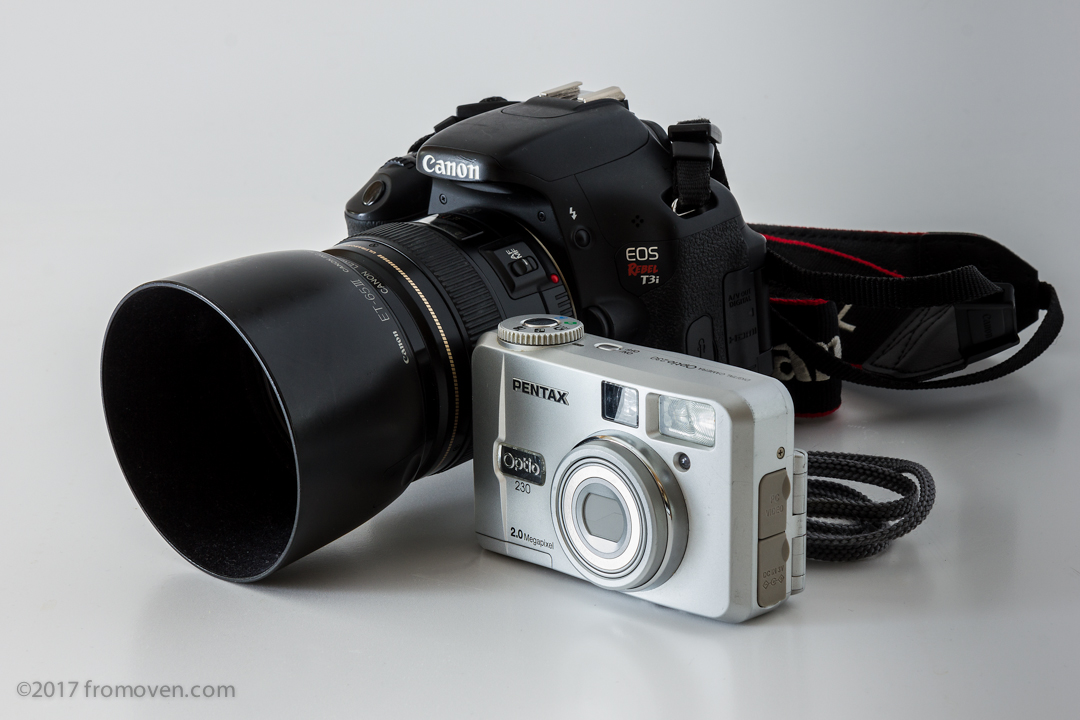
I could remember the advice of a photographer when I was having fun with my first compact digital camera, a Pentax (the picture above) in 2003: “when you’ll want to buy a DSLR, go for good lenses at first”. It remained in my head, but perhaps too far back to pay attention to it years later.
I used the compact to its maximum but I was hungry for more controls, which was not possible with this one. A few years later, I finally decided to buy my first digital single lens reflex. I had my choice on a Pentax istDL because I found the images more beautiful than Canon-Nikon of the same price range. The owner of the store explained to me that Pentax had a good kit lens in its basic model, unlike the others. Obviously, there were other factors but are irrelevant and keep the story short.
After 6 years of beating this Pentax, it began to show fatigue. I turned to a more “common” camera, the Canon. Then, I joined a photo club and poured my hart in this activity. And I got caught up in the game of gear acquisition; In short, I started to have GAS!
Until I came across this video:
It’s viewing this video that the idea came to mind for this article: and if it weren’t about gear… If a guy can make a crappy guitar sound good, then…
In my conquest of photography, I read several articles, books and viewed tutorials. There was a recurring theme that always came back: it is not the camera that makes the photographer but rather his eye that sees the picture. The camera is only the tool to capture that vision.
Moreover, some time ago, I had seen a video in which the photographer Zack Arias had taken up a challenge of street photography with a compact camera and make it work with a cobra flash! I researched this channel for this article, it the channel is DigitelRev. There is also one interesting challenge that I also viewed, that is action and sports photographers:
These two guys had to use a 0.3 megapixel camera!!! I noticed that despite the poor quality of the image, the photos were interesting just by the fact that these photographers had “the eye” for composition.
I myself have put to the test the so-called saying of “we know: you have big cameras that make better pictures” … The context was the following: we had some photo enthusiasts in the office and we decided to take on small challenges to make pictures on a theme, present them at lunch time and then vote on the best pictures. It was during one of these challenges that I heard this comment. So, for the next challenge, I used my iPhone to make my pictures (which ranked 1st in the vote). It was hilarious to see the reactions when I later unveiled that it had been made with my cell phone! In short, it was the composition that had prevailed, not the quality of the camera.
It would be unfair to stop here in the comparison without saying that the equipment can influence the final result. It is obvious that there is a way to work with rudimentary tools and achieve a convincing result. On the other hand, it is when these tools are pushed to their maximum that one realizes their limits. After all, a carpenter would eventually cut the moldings of a doorframe and do a fairly good job, but he would surely gain time with a high-end tool.
I’ll conclude with this: I believe that learning, effort and practice are the best tools that could be acquired in the practice of photography.

