
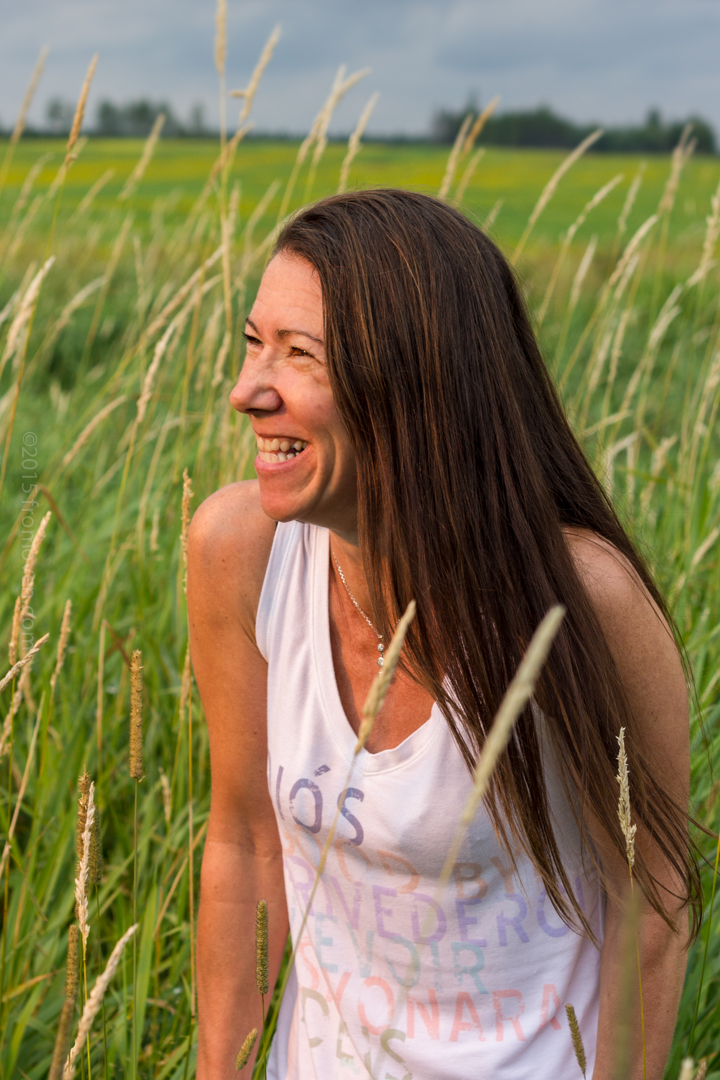
As told in the previous article of my visit in Abitibi, I had good intentions to photograph landscapes. Knowing that there are many abandoned buildings, I was hoping to find something to  photograph. The weather was not too cooperative and the cloud coverage ranged from threatening rain clouds. So I converted this landscape hunting ride for portrait practice. There were several wheat fields, but they were not always accessible. I got lucky and found one that was interesting.
During a break in the rain, I stopped in the entrance of that field where there were just enough wheat to make it look “crowded” and mounted a flash on a tripod. Obviously, the weather was still gray as you can see from the photo “the making of”. Despite the overcast, it was relatively clear. My idea at the time was to simulate the effect of sun in the afternoon with its warm colors. So I added an orange gel and taped it on the flash, set the camera white balance to sunny temperature (which is around 5200K). Then I used a 50mm fixed lens. I wanted to have a shallow depth of field with it’s native aperture of f/1.8. It’s very usefull for a portrait in which the environment is pretty busy. It proved to be impossible with the light conditions: even at ISO 100, I had to go up to a speed of 1/320 and close my aperture at f/5 not to overexpose.
I know I hear you saying: “Isn’t the sync speed 1/200 for Canon?”. Of course it is! But the beauty 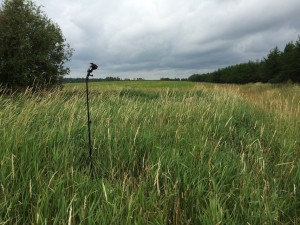 of photography id that you can do little cheating. When the flash is used as a single light to illuminate a subject, the 1/320 speed will inevitably cause the black bar at the bottom of the photo. But in this case, since ambient light was strong enough, the bottom part was be correctly exposed and the flash was adding its light in the top section. So I had my effect “sunset” on the face while restricting the orange color in the bottom section.
It’s a usefull trick to use in wedding photography to illuminate the bride without emphasize the white dress!

